








Modern industries rely heavily on the safe and efficient transport of heavy machinery. Whether in manufacturing, construction, or shipping, evolving technologies are elevating how these challenges are tackled. New tools and engineering breakthroughs have enabled not only streamlined workflows but also stronger safety controls. Innovations in casters and wheels play an essential role, enhancing the maneuverability and security of massive loads while enabling seamless transitions between workstations or job sites.
The pursuit of efficiency is more than matching machine capabilities—it’s harnessing the synergy between smart automation, advanced materials, and ergonomic design. Recent trends show a marked reduction in workplace accidents and labor inefficiencies where these progressive solutions are adopted. As businesses seek to remain agile and minimize downtime, these pioneering tools foster a working environment where both equipment and teams thrive.
Autonomous Forklifts: Enhancing On-Site Logistics
Autonomous forklifts are shaping the future of material handling logistics. By integrating AI-driven perception and decision-making with robust safety systems, these machines offer impressive adaptability to constantly changing work environments. Organizations facing increasing labor shortages turn to autonomous forklifts, which deliver operational reliability and maintain productivity levels without compromising safety. In fact, autonomous forklifts now approach human-level performance when navigating busy job sites, as documented by industry research published on IndustryWeek.
Beyond their immediate labor benefits, autonomous forklifts can reduce costly errors accompanying manual operations. With sensors and AI, they automatically detect and avoid obstacles, recalibrate their routes, and deliver precision transport even in the most crowded warehouses or manufacturing plants. Data analytics from these smart machines further optimize operations by identifying inefficiencies and preemptive maintenance needs, reducing downtime, and maximizing asset longevity.
Self-Propelled Modular Transporters: Versatility in Heavy Load Movement
SPMTs represent a transformative leap in heavy equipment haulage. Composed of modular, multi-wheeled platforms, these machines are engineered for the seamless movement of outsized loads such as bridge segments, power generation components, and shipyard modules. What sets SPMTs apart is their adaptability; multiple units can be linked and synchronized, allowing operators to transport heavy, irregularly shaped objects over both short and long distances.
Industries worldwide employ SPMTs to streamline project timelines and ensure heavy objects reach their destinations undamaged. Their computer-controlled steering and precise movement offer a level of versatility not found in older forms of heavy haulage. Case studies from major North American infrastructure projects highlight SPMTs’ role in reducing both risk and logistical complexity, as well as enabling “just in time” deliveries that help keep operations on schedule.
Advanced Caster Designs: Improving Maneuverability
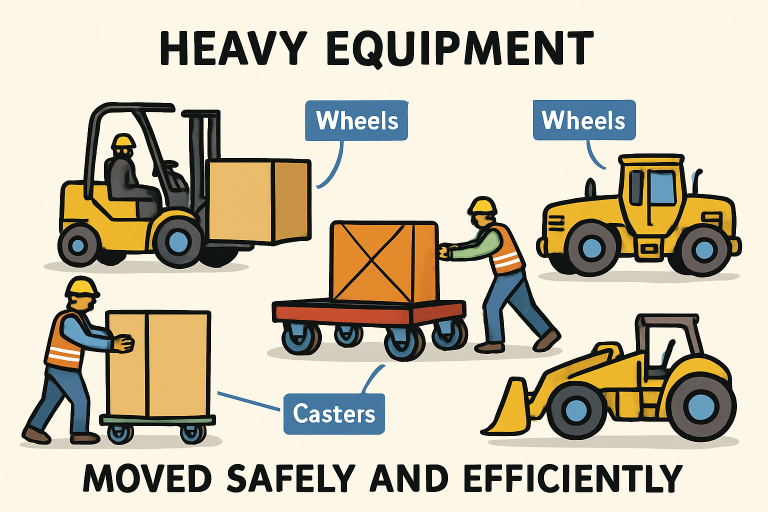
The evolution of industrial caster and wheel design has a direct, tangible impact on workplace safety and productivity. Modern, heavy-duty casters, such as the Hamilton MDD Maxi-Duty Dual Wheel Casters, enable effortless rotation and reliable load-bearing even under extreme conditions. These features prevent inefficiencies arising from mismatched or underperforming hardware and ensure equipment remains mobile, no matter how heavy or unwieldy the cargo.
Innovative casters often incorporate shock-absorbing systems, advanced materials to reduce friction, and ergonomic design principles. These improvements are crucial for operators who regularly handle heavy equipment, helping reduce physical fatigue and minimize the risk of workplace injuries. Safety+Health Magazine guides on choosing the right caster for different work settings, emphasizing the impact of the right hardware on daily operational safety and efficiency.
Intelligent Lift Assist Devices: Reducing Physical Strain
Intelligent Lift Assist Devices (ILDs) are designed to address the persistent challenge of protecting workers from the physical toll associated with heavy lifting. By employing powerful servo drives, smart hoists, and finely tuned feedback controls, ILDs enable a single operator to lift and position large, cumbersome items with minimal manual effort.
The adoption of ILDs dramatically decreases cases of repetitive strain injuries—one of the most common and costly hazards in heavy industry. Their ability to mimic natural movements creates an intuitive experience, empowering workers to focus on accuracy and safety. This shift paves the way for more inclusive workplaces, where a wider range of employees can safely participate in demanding logistics tasks without fear of injury.
Remote Operation and Automation: Enhancing Precision
The ongoing integration of automation and remote operation into heavy equipment transport marks a significant advancement in both accuracy and worker safety. Operators using wireless controllers or centralized systems can execute complex maneuvers from a safe distance, minimizing risk during hazardous tasks. This tech-forward approach leverages advanced sensors, cameras, and connectivity to perform precise positioning and meticulous load handling, even in high-risk zones.
Continued investments in artificial intelligence and machine learning are making these systems smarter, learning from operational data to improve performance with each use. These developments help predict equipment needs, streamline workflow, and continually raise the bar for heavy machinery transport—turning previously daunting jobs into manageable, repeatable routines.
Conclusion
Heavy equipment transportation is experiencing a renaissance powered by trailblazing solutions that put efficiency, precision, and worker well-being at the forefront. From autonomous forklifts to intelligent lift-assist devices and modular transporters to cutting-edge casters and wheels, today’s businesses can embrace innovation to ensure safe, seamless material handling. Companies adopting these strategies position themselves as industry leaders, resilient in the face of disruption and prepared for the challenges ahead.