








Key Takeaways
- Miracle Mixer builds custom paddle drum mixers, batch blenders, and agitators.
- Its double-tumble design is intended to blend materials with differing weights and densities while limiting unnecessary shear.
- The company lists mixer capacities from approximately 5 to 2,600 gallons, with 55-gallon models among its popular sizes.
- Application testing remains important because material behavior, batch loading, moisture, and operating conditions affect results.
- Equipment selection should account for safety, sanitation, loading, discharge, maintenance, and production targets.
Manufacturers that blend ingredients with varying sizes, weights, densities, or flow characteristics often experience inconsistent batches, longer cycle times, and avoidable product loss. Miracle Mixer is an industrial manufacturer of paddle drum mixers, designing batch mixers, blenders, and agitators for applications requiring controlled, repeatable material movement.
Its equipment is positioned for dry ingredients, powders, granules, seeds, feed, food products, chemicals, selected wet materials, and specialty blends. Rather than relying solely on aggressive high-speed mixing, the Miracle Mixer approach uses drum rotation and internal paddle movement to tumble and redistribute ingredients throughout a batch.
Why Do Manufacturers Struggle With Uneven Mixing?
Density, Size, and Flow Differences
Heavy ingredients can settle while lighter ingredients rise or migrate, especially when materials vary substantially in particle size, shape, density, or moisture. This poses a practical challenge in seed blending, fertilizer production, feed premixes, mineral production, food ingredients, and similar processes, where each portion of the finished batch should contain the intended formulation.
Fragile Materials Need Controlled Handling
Seeds, nuts, cereal pieces, dried ingredients, and coated products can be harmed when a mixing process creates excessive impact, abrasion, or shear. A mixer should therefore be evaluated not only for speed, but also for how it moves materials from loading through discharge.
Slow Cycles Limit Throughput
Long mix times can constrain scheduling, labor utilization, and available production capacity. Miracle Mixer states that certain dry, powdered, and non-flowing heterogeneous materials can be mixed up to 10 times faster than with conventional ribbon mixers. That is a manufacturer’s performance claim, not a universal guarantee, and it should be verified with representative product testing.
How Does the Miracle Mixer Design Work?
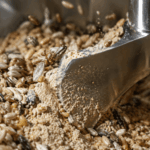
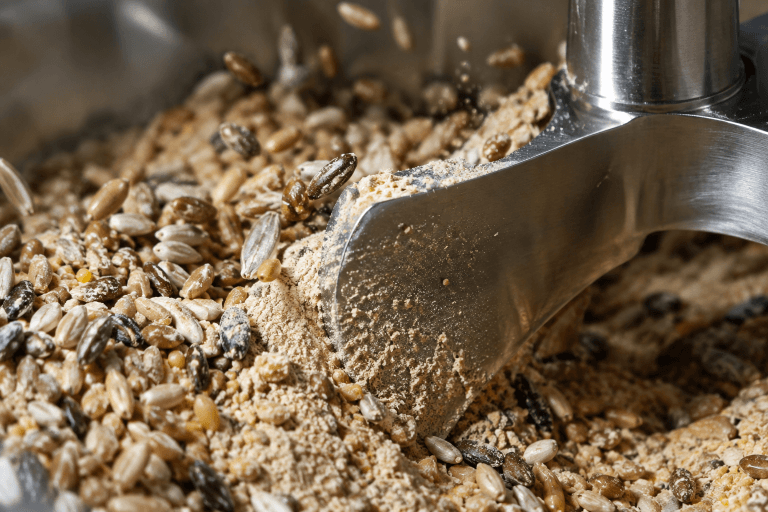
Miracle Mixer describes its equipment as a tumble drum system with an internal rotating paddle arrangement. As the drum rotates, materials are lifted, tumbled, and redistributed. The internal paddle action is designed to add a second movement pattern, which the company calls double-tumble action.
This configuration is intended to move ingredients through the batch without depending entirely on aggressive cutting action. Miracle Mixer also states that its paddle system has no shear points that would damage fragile ingredients. Manufacturers should still test their own materials, particularly when products are coated, moisture-sensitive, highly abrasive, or prone to breakage.
Each unit can be configured around practical process details such as working volume, material bulk density, batch weight, loading method, discharge requirements, controls, cleaning needs, and operating environment. This custom approach matters because maximum drum volume is not the same as the usable working capacity for every product.
What Performance Advantages Does Miracle Mixer Offer?
- Batch consistency: Tumble and paddle movement may help distribute ingredients with different physical properties.
- Gentler handling: The design is suited to applications where minimizing unnecessary shear is important.
- Cycle-time potential: Faster mixing may be possible for suitable applications, subject to validation.
- Maintenance planning: Miracle Mixer attributes part of its value proposition to a design with fewer moving parts.
- Flexible sizing: Custom equipment can better align mixer capacity with actual production needs.
Miracle Mixer reports a 98 percent mixing ratio for its internal mixing system and says the result is higher than that of conventional roto or ribbon systems. It also states that its mixers can cost at least one-third less than some competing systems because the design uses fewer moving parts. Both statements are company-reported claims, so buyers should define their own acceptance criteria for blend uniformity, cycle time, product integrity, ownership cost, and maintenance needs before making a purchase decision.
Which Industries Use Miracle Mixer Equipment?
Miracle Mixer lists applications across agriculture, food processing, chemical processing, pet food, industrial materials, and laboratory-scale work. Examples include grass seed, cover crop seed, bird seed, grain, feed premixes, fertilizer, mixed nuts, cereal, coffee, spices, vitamins, minerals, detergents, liquid soap, winter sand, clay, pet feed, pickles, sauerkraut, and meat marinades.
For seed and grain blending, the priority may be gentle handling and consistent distribution across varieties or ingredients. Feed and premix operations may focus on distributing smaller-volume ingredients through a larger batch. Food processors should also evaluate food-grade construction, sanitation access, cleaning procedures, and cross-contact controls as part of the equipment specification.
How Does Miracle Mixer Support Custom Equipment Projects?
Successful mixer selection begins with material information. A manufacturer should provide particle size, bulk density, moisture content, fragility, abrasiveness, desired batch weight, required cycle time, loading method, discharge method, and cleaning expectations. Miracle Mixer states that new equipment is available across a roughly 5- to 2,600-gallon range.
The company also offers used and reconditioned mixers, with inventory that changes over time. A used unit may be appropriate when its capacity, material of construction, controls, condition, and layout suit the intended process.
How Does Miracle Mixer Compare With Conventional Mixing Systems?
No mixer is ideal for every material. When comparing a Miracle Mixer with ribbon, roto, or other batch mixing systems, buyers should ask:
- Does the mixing motion suit the ingredient density, flow behavior, and fragility?
- What working volume is required at the planned production rate?
- How will blend uniformity and product damage be measured?
- Which components need regular inspection or replacement?
- How will loading, dust control, discharge, cleaning, and controls fit into the complete process?
What Should Manufacturers Consider About Mixer Safety?
Safety planning should include guarding, safe access, emergency controls, lockout procedures, operator training, and documented maintenance. OSHA explains that machine guarding protects workers from rotating parts and ingoing nip points, hazards that must be addressed in the final installation. Guards should be reviewed before operation, and personnel should not be able to reach hazardous moving components while the mixer is running.
How Should a Manufacturer Select the Right Miracle Mixer?
- Define the main problem, such as poor uniformity, material damage, long cycles, or limited capacity.
- Document material properties and establish measurable targets for throughput and blend quality.
- Select a working capacity based on batch weight and production schedule, not drum size alone.
- Review construction, sanitation, controls, loading, discharge, and safety requirements.
- Request testing with representative materials whenever possible.
Frequently Asked Questions
What does Miracle Mixer manufacture?
Miracle Mixer manufactures industrial paddle drum mixers, batch mixers, blenders, and agitators, including custom configurations for a wide range of materials and production requirements.
What materials can Miracle Mixer equipment handle?
The company lists applications involving seeds, grain, feed, fertilizer, food ingredients, pet feed, minerals, chemicals, detergents, coffee, cereal, and other dry or wet mixtures.
Is Miracle Mixer suitable for fragile ingredients?
Its tumble drum and internal paddle design is intended for applications where avoiding unnecessary shear is important. Actual suitability should be confirmed through testing with the specific product.
What should be verified before purchase?
Buyers should verify capacity, blend uniformity, cycle time, product condition, cleaning procedures, safety features, maintenance requirements, installation details, and test results before finalizing a mixer configuration.